

Hearth Fire, Sacred Warrior - Coming to Terms with Self
The story is everything. In fact, our research into the Millennials and Gen Z art appreciation and collecting practices shows their emphasis is much more on the story of art than on its asset-class nature.
They favour art that speaks to the soul, to important social or environmental issues, and to minority cultural views. This feels so right to me. These are all what our art conveys in spades.
Here is one of our own for you today.
The Hearth Fire and the Soulful Mirror
Coming to Terms with Self
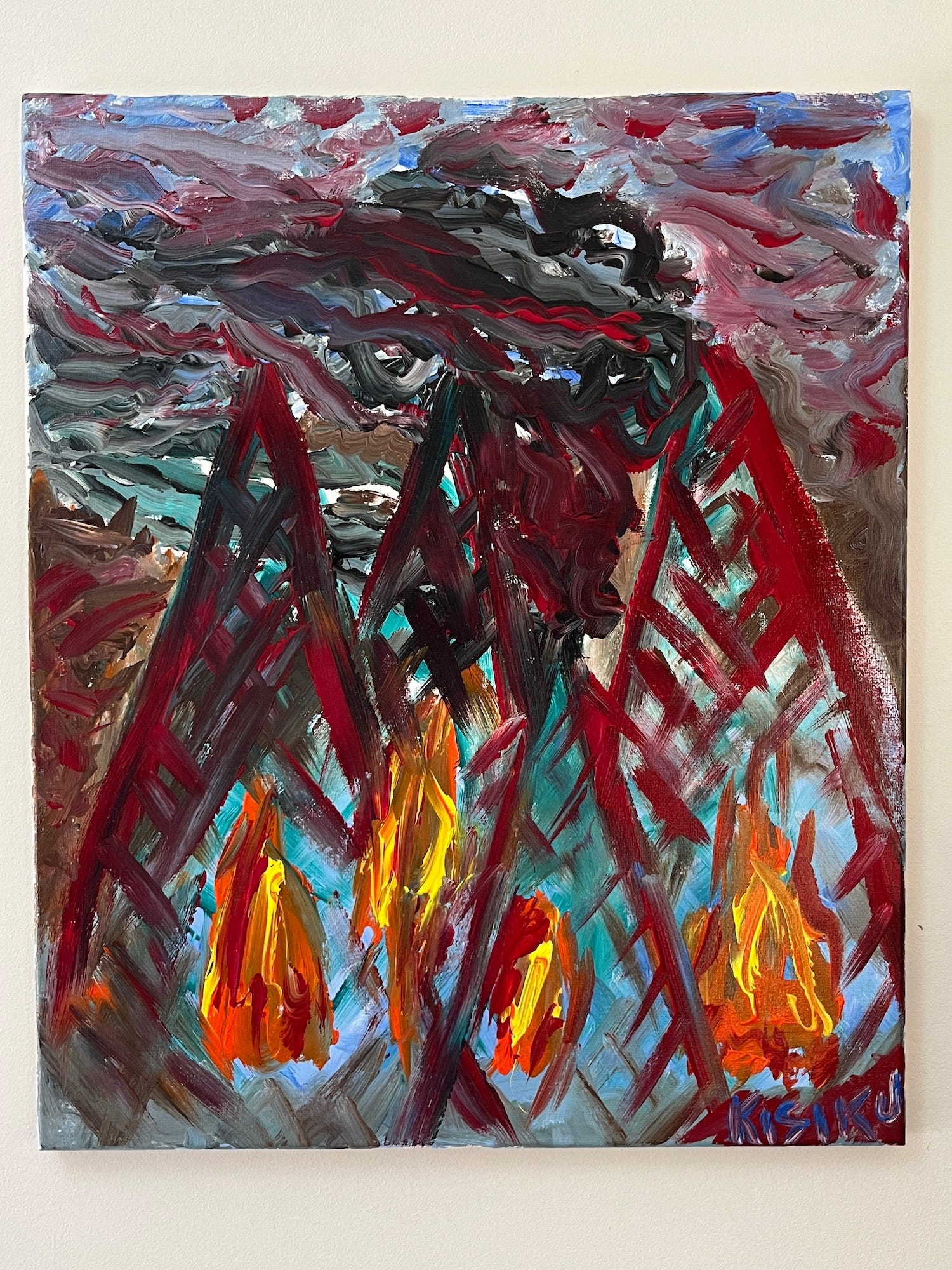
‘Four Fires’ Legacy Collection | Year: 2016 | Medium: Acrylic on Canvas
Size: 50 × 60 × 1.6 cm (19.6 × 23.6 × 0.6 in), Artist: Dr Jorandi Kisiku Joseph Randolph Bowers
Description: Four fires appear from four wigwams where four shamans work at the four winds to protect and uphold the cosmic order. Strength, health, vision and comfort for all. Depth of meaning and power in this work that speaks of truth against all odds, deep commitment to vision, and intuitive insight when the night is most dark and foreboding. Available here.
The Sacred Wigwam
There is an image I often return to in my work, drawn from my connection with the Mi’kmaq nation. It is the image of the wigwam, and within it, the hearth fire. This fire represents the warmth of family, the intimacy of home, and a sacred connection to place. It is a symbol of a cohesive culture, of a people who know who they are and where they belong. It is an image of a true, clear reflection.
This symbol feels more vital than ever today, as it stands in stark contrast to the dominant mirror of our modern world: the distorted, refractive, and often alienating mirror of social media.
As I explored in this month’s video, the experience of putting our vulnerable selves out into the world and having a warped image reflected back to us—once the specific struggle of the artist—has now become a universal human condition.
We are all, as a human family, struggling to connect, yearning for that sense of place and authentic reflection the hearth fire represents.
But what do we do when that voice is misunderstood? How do we hold onto the warmth of our own hearth fire when the reflection from the outside world is so cold?
The answer, I believe, lies in knowing which mirrors to trust. It’s about understanding the profound difference between the noisy public square and the quiet counsel of our own “wigwam.”
Learning to hear and then to listen to your inner voice is a journey in itself. Taking time to sit with your breath is one of the first steps. We rarely actually learn to do this. If you are lucky enough to learn meditation, you are way ahead of the curve.
If not, sitting with your breath is as simple as sitting down and resting your hands on the legs. Placing the feet on the floor or ground. Keeping your back upright. Looking forward or slightly down, so the airways are clear.
Then turning your inner gaze to the breath. Taking a deep breath inward, then holding a second, and exhaling slowly. Then a short pause. Then inhale again… and repeat the process gently.
As you do this, your mind will probably wander to other ideas that cross the mind and/or feelings that come up. Allow all of these to come, then go. Imagine they are like the clouds in the sky, that come and go. You cannot control the sky, so do not try to control the inner mind - allow it to flow.
This is one of the first lessons - the flow means we are part of a process of life unfolding in real time. The action of mind mirrors this organic and fluid nature.
Firm lines do not necessarily exist in nature, they tend to be curved and where there are straight trees and defined lines they are simply part of the creative expressions of the flow in nature.
Human beings are mostly flow, and a little bit of grit and perfume.
Congratulations, you had your first lesson in meditation and mindfulness.